


Studio building AR, VR and mixed-reality software and 3D assets for businesses

Open-source Python library for analysing diffusion MRI and other 3D and 4D medical imaging data

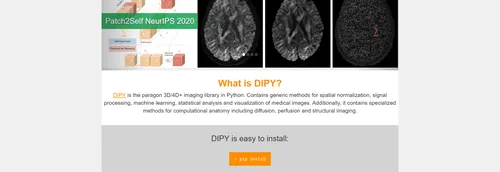
DIPY, short for Diffusion Imaging in Python, is an open-source Python library. Its main emphasis is diffusion MRI of the brain. The library also covers normalizing images across space, processing signals, applying machine learning, statistics and visual display of medical scans, along with specialized methods for computational anatomy, including diffusion, perfusion and structural imaging. The project describes itself as a user-friendly library that keeps growing, and it is written in Python.
The library provides a wide range of diffusion models. For single-shell data it includes methods such as DTI, CSA, SFM, SDT, Q-Ball and CSD. For multi-shell data it includes GQI, DTI, DKI, SHORE, MAPMRI and MSMT-CSD, and the project says there are many more. These models let researchers estimate the structure of tissue from the way water diffuses through it.
DIPY offers affine registration, diffeomorphic 2D and 3D registration, and registration based on streamlines, which aligns the fiber pathways of different scans. Its tractography options include probabilistic tracking, deterministic tracking and PFT tracking, which follow white matter pathways. The project also supports analysis approaches such as BUAN, AFQ and K-fold cross-validation, which help researchers compare pathways across people.
The preprocessing tools include Patch2Self, non-local means, Gibbs unringing, MP-PCA and L-PCA for reducing noise and artifacts. The library also offers brain extraction, estimation of the signal-to-noise ratio and the reslicing of datasets, so that data can be prepared before analysis.
The library visualizes orientation distribution functions and provides interactive tractogram viewing, with an advanced user interface and shaders. Every algorithm can be run from the command line, and the project says users can also create their own algorithms, which makes the library suited to workflows that need to be repeated across many scans.
The project's own methods have appeared in peer-reviewed journals. These include BUAN, published in Scientific Reports in 2020, EVAC+, published in Communications Medicine in 2024, and BundleWarp, published in Medical Image Analysis in 2026. The project's site presents these as examples of methods built on the library and developed through research.
The project is open source, and it notes that partners can provide professional support and services. These cover consulting, custom development and training for organizations that need help with their imaging work. The project lists its sponsors, which include funders that have supported its development, and it asks users to cite the original 2014 paper when they publish work that relies on it.
Diffusion Imaging in Python, known as DIPY, is an open-source Python library for 3D and 4D medical imaging, with a particular focus on diffusion MRI of the brain. It provides general methods for spatial normalisation, signal processing, machine learning, statistics and visualisation, plus specialised tools for computational anatomy.
The library serves neuroimaging researchers and developers; partners offer consulting, custom development and training for organisations that need help.
Summary written by TrustList from the business's own published information, Nov 2026.
Used it? Your experience helps other buyers decide.
Write a reviewNo questions yet. Be the first to ask about Diffusion Imaging in Python.
Similar listings buyers compare against this one.
Studio building AR, VR and mixed-reality software and 3D assets for businesses

Provider of pre-vetted, full-time software developers who join client teams as an extension of in-house staff

Custom software company building AI products, auction and marketplace platforms, SaaS and logistics systems

Electronics design consultancy providing hardware, embedded software, testing and manufacturing support for product teams

Marketplace linking overseas employers with small software firms in India and nearby countries for outsourced projects

Digital biomarker platform for collecting patient-reported outcomes and objective health data in clinical research

Software company building dedicated development teams, system integrations and process automation for e-commerce businesses

Bogotá software company building custom applications, mobile apps and e-learning, plus AWS cloud consulting
Articles that share the Washington tag or mention this listing.
 Seattle
11 Nov 2026
Customer-managed Linux fleets must upgrade the worker agent to 0.33.0; AWS says service-managed fleets were fixed on its side and Windows…
 Seattle
11 Nov 2026
Bulletin 2026-178-AWS is rated Important and affects macOS and Linux hosts shared by several users; the tool was formerly Amazon Q…
 United States of America
10 Nov 2026
CVE-2026-124194 lets a crafted file make Outlook connect out without its usual warning, leaking credentials. CISA has given US agencies…
Everything here links back to the same verified catalogue. Pick your next stop.


