


Dispatch and billing software for fixed-route and non-emergency medical transportation operators

Public Transportation Software
Pantonium
On-demand transit software that treats a whole city as one zone and routes buses to match rider demand
By Pantonium
- Billing & Invoicing
- Work Order Management
- Employee Management
- Order Management
- +20 more
About Pantonium
On-demand transit that treats a city as one service area
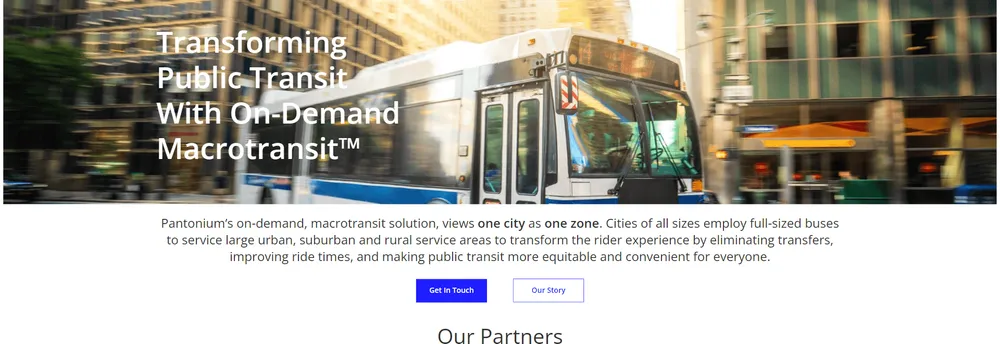
Pantonium builds software for on-demand public transit, around a model it calls Macrotransit. Rather than splitting a city into small microtransit zones or fixed routes, the system treats the city, its suburbs and its rural edges as one service area. Full-size buses are dispatched to riders according to the demand that exists at that moment, and the company says the approach is meant to give communities more transit with the vehicles they already have.
Matching vehicles to riders in real time
The system looks across the whole service area, in real time, at the vehicles available and at the passengers requesting rides. Routing algorithms and artificial intelligence then match each request to a vehicle, adjusting routes and schedules as conditions change. The company says this removes the need for transfers, shortens ride times and reduces the number of vehicles needed for each trip. Its technology is described as a web-based platform that lets an agency run its operations from one central point.
Less manual dispatching
The company presents its approach as a way of running a transit service without a team of dispatchers making the decisions by hand. Its stated aim is to lower the cost of running the service and reduce administrative work, with the algorithm optimizing each trip so that it is as efficient as possible. The company says its staff help each agency adopt the system step by step, including the change in how the operation is managed.
Planning, simulation and data
Transit planning and simulation are part of the offer. The company analyses service data to help an agency design its routes and levels of service, and it can model how a service would perform before any change is made. The company describes this as a way to test the effect of decisions on riders and on the budget, so that an agency can see the likely result before it commits resources.
Communities and partnerships
The company works with communities of different kinds, including urban centers, rural areas and Indigenous communities, to learn what transit needs each one has. It says its technology is designed to serve communities with fewer vehicles and to reduce costs and emissions, and it describes a pilot in Sioux Falls, South Dakota. The company reports that the system is in use in more than a dozen transit services.
Transit agencies and the riders they serve
Transit agencies are the main customers, from the operators of small community networks to larger systems that want to offer flexible services alongside fixed routes. The company says the model works for cities and for their rural edges, where fixed routes often run half empty and microtransit zones leave gaps between areas.
Aims for the public
The company frames its work around the riders themselves: people who need to get to work, school, medical appointments or shops, and who are not well served by timetables that do not match their needs. It says the platform is intended to make public transport more equitable and convenient, and to help cities do more with the resources they have.
TrustList summary
Pantonium makes on-demand public transit software built around what it calls Macrotransit. Instead of splitting an area into small zones or fixed routes, the system treats a city, its suburbs and rural edges as one service area. It then matches vehicles to rider requests in real time using routing algorithms and artificial intelligence.
What Pantonium offers
- On-demand Macrotransit platform: routes full-size buses according to current demand.
- Transit planning and simulation: data analysis to design services.
- Community partnerships: work with Indigenous and rural communities.
- Deployment support: staff help agencies adopt the system.
Who it serves
Transit agencies and communities of different sizes, covering urban, suburban and rural service areas. The company reports a pilot in Sioux Falls and says the system runs in over a dozen transit services.
Key facts
- Approach: one unified service area rather than microtransit zones
- Aims: shorter rides, fewer transfers and lower emissions
Summary written by TrustList from the business's own published information, Nov 2026.
Categories & features
- Billing & Invoicing
- Work Order Management
- Employee Management
- Order Management
- Scheduling
- Dispatch Management
- Routing
- Barcoding/RFID
- Customer Management
- Fleet Management
- GPS Tracking
- Mileage Tracking
- VIN Lookup
- Driver Data
- Driver Logs
- Fixed Route Management
- Multiple Route Support
- Paratransit Management
- Web-Based, Cloud, SaaS
- In Person
- Live Online
- Webinars
- Documentation
- 24/7 (Live Rep)
Pantonium rankings
Pantonium is ranked on 1 TrustList ranking at #41.
Every ranking orders its listings by their reviews, how complete the profile is and the Trust Score. Pantonium has no reviews yet and 3 of the 10 profile details we look for. Where no listing on a page has been reviewed, the order follows the profiles alone.
Fleet management software · 1 ranking
- #41of 78Fleet management software
It is one of 2 here listing driver logs and multiple route support.
Of the top 66 here, 40 also cover billing & invoicing and 35 also cover order management.
Behind Turnit Ride, ahead of ServiceTracker.
As of 2026-11-16. Organic ranks only; sponsored placements are never ranks. How TrustList ranks
Request a demo or quote from Pantonium
Reviews
Write the first review of Pantonium
Used it? Your experience helps other buyers decide.
Write a reviewQuestions & answers
No questions yet. Be the first to ask about Pantonium.
Pantonium alternatives
Similar listings buyers compare against this one.

Planning, scheduling and operations software suite for bus, subway, tram and light rail agencies

SaaS platform that plans and schedules vehicles and drivers for large public transit operations


Transit operations platform for on-demand, paratransit and fixed-route services run by agencies and providers
Related reading
Articles that share the Billing & Invoicing tag or mention this listing.
 Spain
9 Oct 2026
Spain sets rules for its public e-invoicing platform, SPFE
Using the tax agency's platform is optional, but any invoicing software outside it must send a UBL copy of each invoice. Deadlines for…
 United States of America
11 Nov 2026
Toyota revives Scion with the KEI-01 kei truck for US fleets
Scion by Toyota is billed as a "freedom lab"; its first vehicle, a 660cc four-wheel-drive utility truck, will be assembled at Toyota…
 United States of America
10 Nov 2026
Honda recalls 635,808 Pilots and Acuras over power steering software
Honda traces the fault to a division by zero in a supplier's steering code that switches assist off. Dealers will reprogram the control…
Keep exploring
More on TrustList
Everything here links back to the same verified catalogue. Pick your next stop.
- More Billing & InvoicingBack to the ranked category
- Write a reviewHelp other buyers decide
- CompaniesAgencies, consultancies and IT service providers, ranked by verified reviews.
- ArticlesGuides, comparisons and research from the editorial desk and the community.
- AwardsAnnual recognition decided by verified reviews and an independent jury.
- LaunchesNew products and releases, voted up by the community every day.
- AI ModelsBenchmark scores and community ratings for every major model.
- RequestsBuyers describe what they need; vendors respond directly.
- PeopleReviewers, authors and makers with public profiles.
- ComparePut up to four listings side by side before you shortlist.